About

The Salem Heritage Trail guides visitors from around the corner and around the world through over 400 years of Salem history. The themes of the trail bridge connections from the land’s earliest settlement to the Salem we see today with focuses on local Indigenous Peoples, Colonial Salem and the Witch Trials, the Age of Sail, Industrial Heritage, Abolitionism and African American Stories, Immigrant Experiences, Religious Diversity, and Contemporary Salem.

Originally created in the 1980s as a self-guided walking tour, the Salem Heritage Trail was designed to help visitors navigate Salem’s historic downtown and experience its many landmarks at their own pace. Inspired by the concept of a continuous path similar to Boston’s Freedom Trail, the route was first marked with a painted red line along city sidewalks. In 2020, the trail was reimagined with a renewed commitment to inclusivity and community engagement, including the transition to the trail’s current yellow line design.

There is no official beginning or end to the Salem Heritage Trail. Visitors are encouraged to join the trail wherever they are in the city and explore Salem’s history in their own way and at their own pace.

Click to see the Salem Heritage Trail Mobile App

For anyone wishing to revisit Salem or for those unable to visit in person, try our 360° Experience


Historic Sites

The Salem Heritage Trail is a tool for exploring historic Salem on foot. Hop on the trail in the middle or on one of the ends, and follow it through historic downtown Salem to the edge of the McIntire Historic District and along the Essex Street Pedestrian Way to Derby Street and the Salem Waterfront District.

  • Charlotte Forten Park

    Built on land reclaimed from the South River, this plot has historically been the site of many wharves and warehouses.…

  • The House of The Seven Gables

    “Half-way down a by-street of one of our New England towns, stands a rusty wooden house, with seven acutely-peaked gables...”…

  • East India Marine Hall

    The venerable granite façade of the East India Marine Hall, erected in 1825, is the nucleus of the Peabody Essex…

  • Salem Maritime National Historical Park

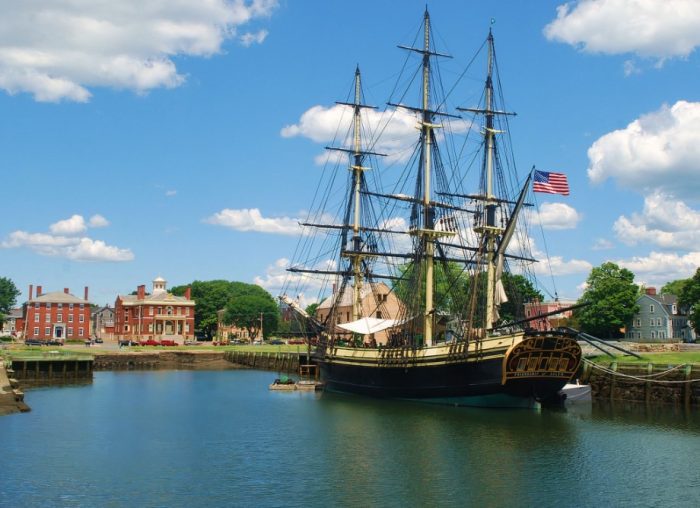
    On March 17, 1938, Salem Maritime was established as the first National Historic Site created by the National Park Service.…

  • Salem Arts Association

    159 Derby Street is a testament to the rich commercial and immigrant history that the old houses of Salem contain.…

  • Nathaniel Hawthorne Statue

    One of the last works of a famous sculptor, this statue of Nathaniel Hawthorne depicts the writer near the end…

  • Derby Square

    Old Town Hall, built in 1816 and 1817, is the oldest surviving municipal building in Salem. This desirable stretch of…

  • Lappin Park

    For nearly four centuries, this has been the central intersection of Salem, and many important events in American history occurred…

  • Salem Witch Museum

    During the Salem witchcraft trials of 1692, this site was home to Reverend John Higginson, minister of Salem's First Church,…

  • Charter Street Cemetery

    The oldest settler cemetery in Salem, the Old Burying Ground was begun by 1637. The town selected a point that…

  • Witch House/Corwin House

    Essex Street, which runs beside you, was once an indigenous pathway along the peninsula of Salem from the woods to…

  • Witch Dungeon Museum

    The English settlers knew that their presence in Salem immersed them in a web of global conflicts. Fearing reprisals from…

  • Salem Common

    This eight-acre park was originally a swampy piece of land dotted by five ponds. Early English settlers in Salem drew…

  • Roger Conant Statue

    In 1913, Henry Hudson Kitson, famous for the Lexington Minuteman Memorial, sculpted this statue of Roger Conant, the founder of…